


Women’s Wader Buying Guide
The Bathroom-Break Problem in Women’s Waders: What Actually Matters Before You Buy
There are gear problems people love to talk about in public—breathability, gravel guards, seam count, pocket layout—and then there are the ones that quietly shape the entire day. For women shopping for fishing waders for women, bathroom access belongs firmly in the second category.
It is not a minor convenience detail. It changes how much water you drink, how heavily you layer, how far you are willing to walk from the truck, how long you stay out when the fishing is finally good, and how comfortable you feel asking your gear to work with your body instead of against it.
That matters even more now that more women are fishing than ever: the 2025 Special Report on Fishing found that 21.3 million women fished in 2024, the highest number on record, and women accounted for 37 percent of fishing participants.
Boating and fishing also remained the nation’s largest conventional outdoor-recreation activity in 2024, generating $38.4 billion in value added.
Most wader content still treats this as an awkward footnote. It should be treated as a performance question.
In This Guide
Why You Should Trust Us
This is not a topic that has to be imagined from afar. The point of view behind this piece comes from women-centered fishing and gear thinking that begins with a familiar frustration: ill-fitting waders, “shrink-it-and-pink-it” design, and the feeling that women were expected to adapt to gear that never truly considered how they move or fish.
It is also shaped by the way Fishe has long framed the category itself: function first, style still intact, and a refusal to treat women’s needs as secondary or decorative.
And that tension shows up in customer research too. One strong audience segment leans hard into technical performance, durability, and self-sufficiency, while another still expects function and expression to coexist instead of forcing a false choice. That matters here, because the bathroom-break question sits exactly at that intersection: real-world function, lived comfort, and the dignity of gear that actually works.
The Issue Most Buying Guides Still Underplay
When men talk about waders, the conversation often centers on durability, waterproofing, and price. All of those matter for women too. But for many women, the deeper buying question is more practical: What happens when I have to use the bathroom halfway through a cold day, in layers, far from privacy, without turning the whole process into a miserable production?
That question reaches into almost every other decision:
- what you wear underneath
- whether you choose bib-like bulk or lower-profile layering
- whether you stay hydrated on long days
- whether you fish remote water or hug the access road
- whether you look back on a long day as hard in a satisfying way or hard in an avoidable one
Usability is performance. If a wader design makes you cut the day short, avoid drinking water, or dread the logistics of being out there, it is not just inconvenient. It is underperforming.
There is a reason the industry has moved more explicitly toward women-specific fit and function.
Patagonia says its women’s waders are designed by women anglers for women anglers; Orvis highlights ergonomic stretch design in its women’s line; and Simms emphasizes women-specific fit and arrangement in its wader messaging.
That shift is a quiet admission that women’s wader design is not just about scaling down a men’s product. It is about rethinking how the product works in motion, over time, and under pressure.
Why Bathroom Access Changes More Than Bathroom Access
The obvious issue is speed. The less obvious issue is the cascade effect.
A wader that is awkward to get in and out of affects how women layer for cold weather, whether they avoid extra insulation to reduce hassle, whether they feel comfortable fishing farther from facilities, and how much friction accumulates during repeated wear.
On a mild afternoon with easy access, you may shrug that off.
On a windy river day with three layers underneath, a shell on top, numb fingers, and no privacy beyond some brush, it suddenly becomes one of the most important design features on your body.
That is why this is not really an article about bathroom breaks alone. It is an article about:
- all-day comfort
- confidence in remote settings
- real layering logic
- movement and flexibility
- whether your gear respects the actual conditions of a fishing day
A feature can sound clever on a product page and still be wrong for how you fish. A simpler design can look less impressive online and still be exactly right in practice.
The Three Wader Designs That Matter Most
Zip-Front Waders
Zip-front waders are the design most likely to make women say, “Oh, now someone finally thought this through.”
Patagonia’s women’s Swiftcurrent Expedition Zip-Front Waders combine a submersible front zipper with quick-release suspenders, chest-to-waist conversion, and a rear-buckle drop-seat system; Patagonia’s broader wader guidance also explicitly says zip-front waders make temperature control and bathroom breaks easier.
In other words, the zip-front category is not just about access. It is also about ventilation, layering, and how quickly you can adapt when conditions shift.
In practice, zip-front designs tend to be strongest for women who:
- fish long days
- layer heavily in cold conditions
- fish remote water often
- value speed and minimal hassle
- are willing to pay more for convenience they will actually use
The case for them is simple. If you fish enough, the convenience stops feeling luxurious and starts feeling rational.
The heavier your layers, the colder the weather, and the longer the day, the more compelling zip-front access becomes.
The tradeoff is also real. Zip-front waders are usually more expensive, and any system with more hardware asks for more care.
Simms maintains specific repair resources for wader zippers, while Patagonia and Orvis both maintain dedicated wader care and repair guidance.
That does not mean you should avoid zipper waders. It means you should buy them the way you buy any higher-feature tool: because you will use the feature enough to justify the complexity.
Drop-Seat Waders
Drop-seat designs are often the smartest middle ground for women who want better access without paying full zip-front prices.
Patagonia’s women’s Swiftcurrent Traverse Waders use a low-profile center-back buckle drop-seat system for quick bathroom breaks, along with articulated legs and seat construction designed for mobility and reduced seam stress. That combination helps explain why drop-seat designs appeal to anglers who want a cleaner chest and abdomen area, less front hardware, and a more streamlined feel.
The best argument for a drop-seat wader is not that it beats zip-front in every situation. It does not. The argument is that it can deliver a meaningful improvement in usability without the premium of a waterproof front zipper.
Drop-seat designs often make the most sense for women who:
- want better access than a traditional wader offers
- dislike the idea of a front zipper or extra bulk there
- fish often enough to care, but not always in extreme conditions
- want a more balanced comfort-to-price ratio
The caveat is that access in theory is not always access in practice. A rear or buckle-based relief system can still be less intuitive when you are layered heavily, wearing a jacket, or moving fast in bad weather.
Some women love the simplicity. Others find it just fiddly enough to keep longing for a front zip.
Traditional or Non-Convertible Waders
Traditional waders are not wrong. They are just the design most likely to expose the bathroom-break issue in full.
That category can still make sense when cost matters most, when fishing days are short, or when you are rarely far from easy access. Orvis’s Women’s Clearwater Waders, for example, emphasize reduced bulk and side-release buckles for waist-high conversion on warm days, showing how simpler builds can still improve comfort and versatility without becoming full relief-system waders.
This kind of design often suits anglers who:
- are buying their first waders
- fish shorter sessions
- stay close to the road, lodge, or boat ramp
- care more about simplicity and price than convenience features
- are still learning what they actually value most
But this is also the category where women are most likely to discover their real non-negotiables the hard way.
A wader can fit beautifully in the living room and still become frustrating once the day includes cold fingers, layered clothing, a rain shell, or repeated wear.
Traditional waders are usually the most affordable place to enter the category. They are rarely the most forgiving once the day gets complicated.

Women’s Wader Option
Orvis Women’s Clearwater Wader
Built specifically for women with a modern, lower-bulk fit, waist-high conversion, anatomical neoprene booties, and integrated gravel guards.
View the Clearwater WaderWhich Design Works Best in Actual Use?
Here is the clearest way to think about it.
Zip-front wins on speed, ease, and cold-weather practicality.
It is usually the best choice for women who fish often, fish far from facilities, or know they hate gear friction.
Drop-seat wins on compromise.
It can meaningfully improve bathroom access while keeping price and front-end complexity lower.
Traditional wins on simplicity and entry cost.
It can be absolutely fine for shorter days, lighter use, and women who are still figuring out whether waders will be a central part of their fishing life.
What matters is not abstract “best.” It is your pattern of use.
A woman who fishes three cold, full days a week on rivers with limited privacy should not evaluate waders the same way as someone who fishes summer evenings near home.
A woman who layers aggressively, drinks plenty of water, and hikes into remote access points will feel access design differently than someone who primarily fishes boat ramps and easy walks.
That is why generic “best women’s waders” lists often miss the point. They compare products.
They do not always compare the life those products create.

Performance Wader Option
Orvis Women’s PRO Wader
An athletic-fit option with a four-layer Cordura® upper, five-layer lower legs, gusseted crotch, low-profile seams, and anatomically shaped neoprene booties.
View the PRO WaderWhat Feels Fine in the Shop Can Fail on the River
This is where a lot of women make expensive mistakes.
A wader can seem comfortable when you are standing upright for four minutes in a store or trying it on over leggings at home. That tells you almost nothing about what it will feel like:
- after two hours of walking and wading
- with a base layer and midlayer underneath
- while crouching, climbing, and getting in and out of a boat
- with a rain jacket over the top
- when you suddenly need the bathroom in bad weather
Comfort is cumulative. The little annoyances that seem tolerable at first become the thing you remember by midday.
That is also why women-specific patterning matters beyond marketing language.
Patagonia calls out articulated legs, an articulated seat, and lower-volume anatomical booties in its women’s waders; Orvis emphasizes ergonomic stretch; Simms centers women-specific fit.
These are not glamorous details, but they shape how seam placement, mobility, and bulk behave over time.
If the access system works but the fit pinches, sags, binds, or bunches once layered, you have not really solved the problem.
Cold Weather Is Where the Difference Gets Brutally Clear
In warm weather, almost any relief system can seem manageable. In cold weather, the margin for hassle gets much smaller.
Orvis’s layering guidance emphasizes moisture management under breathable waders, because warmth depends on staying dry and regulating sweat rather than simply piling on bulk.
That matters here because the more thoughtfully you layer, the more you need your access design to cooperate with those layers instead of fighting them.
Layering Options for Cold Days

Charvana Thermal 1/4 Zip Top
A brushed, breathable midweight top made to layer under waders.

HaliBorealis Thermal 1/4 Zip Top
A breathable brushed thermal layer designed to fit under waders or outerwear.

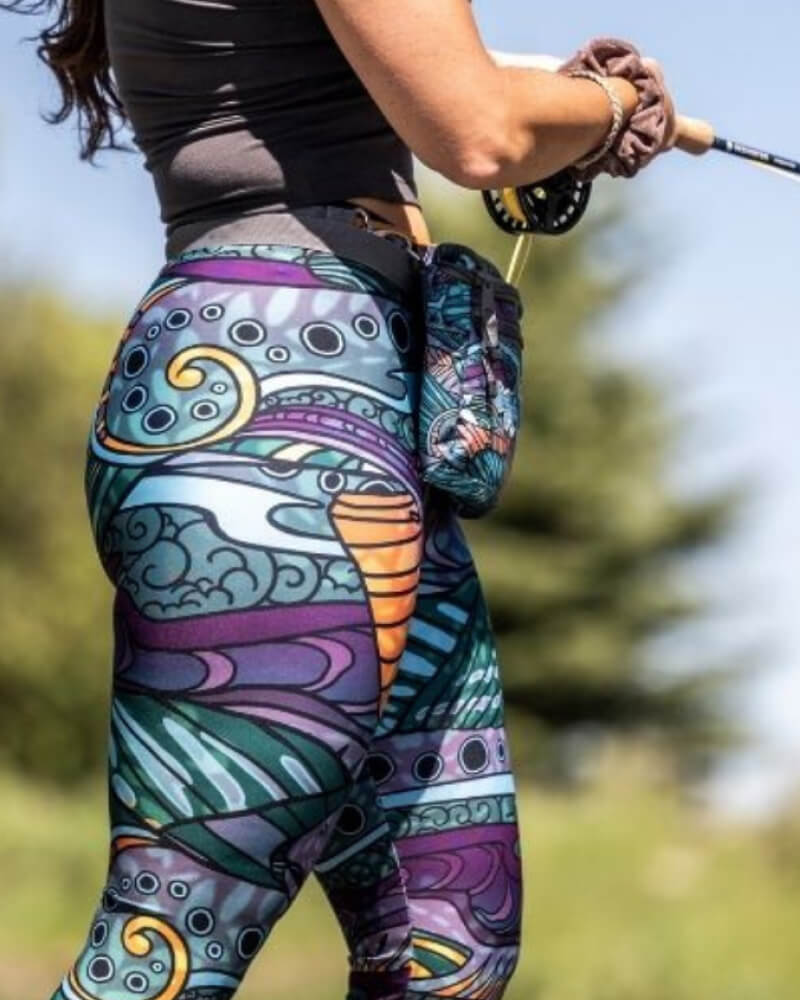
Beauty and the Bonefish Pocket Leggings
A current Fishe bestseller with a high-rise waist and flexible stretch fabric.
A few things happen in cold conditions:
- You wear more.
- You move slower.
- Your hands are colder.
- You are less willing to fully disrobe.
- You are more likely to delay a break until it becomes urgent.
That is where front-zip waders often justify their price. They reduce how much you have to undo.
They also make ventilation easier when you are hiking in, overheating, or adjusting between cold mornings and milder afternoons. Patagonia explicitly positions zip-front waders around both bathroom access and temperature control for exactly that reason.
If you mostly fish shoulder seasons, winter, or cold rivers, this should carry more weight than it does in many buying guides.
The Most Common Regrets Women Have After Buying Waders
The first regret is assuming waterproofness and fit are the only serious criteria.
They are not.
The second is buying for the store try-on version of fishing instead of the actual day. It is very easy to choose a wader based on price, fabric, or brand reputation and only later realize that the feature you needed most was the feature you treated as optional.
The third is underestimating how often “just dealing with it” changes behavior.
Women will sometimes quietly adapt around gear friction: drink less water, avoid remote spots, skip extra layers, or cut days short. Gear that causes that kind of adaptation is costing more than its retail price suggests.
The fourth is ignoring maintenance. Orvis notes that with proper care, fly-fishing waders typically last three to five years, and major brands all offer repair pathways.
A wader with more features is not automatically fragile, but it is worth treating like serious equipment rather than disposable apparel.
So What Should You Actually Prioritize Before You Buy?
Start here, in this order:
First, ask how often you fish and how long you stay out.
If you fish often or stay out all day, convenience becomes performance very quickly.
Second, ask where you fish.
If you are often remote, far from facilities, or in places with limited privacy, access design matters more.
Third, ask what you wear underneath.
Heavy layering increases the value of easy access.
Fourth, ask how much hassle you are willing to tolerate.
Some women genuinely do not mind simpler systems. Others know one awkward experience will sour the whole purchase.
Fifth, ask whether you are buying for right now or for the way you want to fish.
If you expect to fish more, travel more, or stay out longer, buy for that version of yourself.
That is the real logic behind a strong women’s wader buying guide. Not “best” in the abstract. Best for your body, your habits, your weather, and your patience.
Frequently Asked Questions
Are zip-front fishing waders for women worth the extra money?
Usually yes, if you fish often, layer heavily, or spend long days far from easy facilities. The more often you deal with cold weather, remote access, and repeated bathroom breaks, the more that convenience tends to feel worth paying for.
Are drop-seat waders better than zip-front waders?
Not universally. Drop-seat waders are often a strong middle-ground option: better access than traditional waders, less front hardware, and usually lower cost than zip-front models. Zip-front still tends to win on speed and ease in tougher conditions.
Can traditional women’s waders still work well?
Absolutely. They can be a smart choice for beginners, shorter outings, and anglers who fish close to easy access points. They just become less appealing as days get longer, colder, and more logistically complicated.
Do women really need women-specific waders?
For many anglers, yes. Women-specific patterning can improve mobility, layering comfort, seam placement, and overall usability, especially over long days. It is not just about size; it is about how the garment behaves in motion.
What matters more: fit or bathroom access?
You need both. A relief system will not save a wader that binds, sags, or layers poorly, and a great fit can still become frustrating if access is miserable. The best choice balances body comfort with real-life usability.
What should I wear under waders in cold weather?
Think in smooth, moisture-managing layers rather than bulky ones. Breathable waders work best when your base and midlayers manage sweat and warmth without bunching. The more layers you wear, the more valuable an easy-access wader design becomes.
Choose for the Day You Actually Fish
The bathroom-break problem in women’s waders is not awkward trivia. It is one of the clearest examples of whether a piece of gear was designed for real life or just for a product page.
The right wader is not simply the one with the toughest fabric, the most premium membrane, or the loudest reputation.
It is the one that lets you move, layer, wade, wait, and stay out longer without turning a basic human need into a disruptive event.
For some women, that will mean paying more for a zip-front system and never regretting it.
For others, a drop-seat design will hit the sweet spot. For plenty of anglers—especially newer ones—a simpler traditional build may still be enough for now.
The key is to stop treating this issue like an embarrassing extra and start treating it like what it is: a central part of comfort, confidence, and performance on the water.
If you are comparing fishing waders for women, rank access design right alongside fit, durability, and price before you buy.
Compare options by how you actually fish—not just by specs—and choose the design that will keep you comfortable enough to stay on the water longer.
Shop Women’s WadersRelated Reading

Fishing Waders for Women: Best Fit, Comfort & Performance
Start with the broader guide to fit, movement, construction, and on-water performance.

Fishing Waders for Women: What to Wear Underneath
Build a smoother layering system for warm, dry, comfortable days in your waders.

Women Fishing Boots Guide: Stability and Comfort
Compare the traction, support, fit, and comfort features that matter below the wader.
