


Fishing Culture & Outdoor Participation
What 183 Million Outdoor Lives Mean for Fishing
The campsite wakes before the people do.
Mist lifts from the lake in pale ribbons. Somewhere inside a tent, a sleeping bag rustles. A stove clicks, then catches. Coffee begins its slow morning work.
At the shoreline, a child is already throwing stones into the stillness. One skip. Two. Three.
Then something moves beside the reeds.
It may be a trout lifting toward the surface. It may be a bass turning in the shallows. It may simply be the wind changing its mind.
Still, someone reaches for the fishing rod leaning against a tree.
This is how a life outdoors often begins.
Not with a carefully organized expedition. Not with a truck full of equipment or generations of inherited knowledge. It begins because the water is close, the morning is open, and someone wonders what might be living beneath it.

Across America, more people are stepping outside than ever before. But the richer story is not simply how many have arrived. It is what may happen when they find the water.
Key Takeaways
183.2 million
Americans participated in outdoor recreation in 2025.
21.3 million
Women participated in recreational fishing in 2024.
39%
Of first-time anglers in 2024 were women.
In This Story
Why You Can Trust This Story
This article draws on current outdoor participation research and the 2025 Special Report on Fishing, then brings those numbers back to the human moments that make someone want to return to the water.
The Largest Outdoor Community America Has Ever Known
Outdoor participation reached a record 183.2 million Americans in 2025—nearly 60% of everyone in the country age six and older.
Another 2.1 million people joined the outdoor community in a single year. Since 2019, close to 30 million new participants have walked through its wide, unofficial gate.
It is an extraordinary number, but numbers this large can become strangely distant. It is easier to understand 183.2 million as a collection of smaller scenes.
A grandmother showing her granddaughter how to hold a rod. A woman taking her first solo camping trip and packing a fly box she is not entirely sure how to use. A family stopping beside a river because the children are restless and the water looks inviting. A hiker discovering that the clear creek beside the trail is not merely scenery. It is alive.
More than half of today’s outdoor participants have fewer than ten years of experience. A significant part of this enormous community is still learning its language, forming its habits, and deciding which parts of the outdoors will become part of who they are.
They may not know how to read a river. They may not know which knot holds or which fly belongs in which season. They may not yet call themselves anglers.
Fishing’s future may already be standing at the water’s edge, waiting for someone to offer a rod.
One Good Night Outside
Camping has a peculiar way of rearranging time.
The day no longer begins with traffic and ends beneath a ceiling. Meals become simpler. Phones lose their urgency. The distance between a person and the natural world becomes the width of a tent wall.
Perhaps this is why camping remains such a powerful doorway into outdoor life. More than nine out of ten campers also participate in activities such as fishing, hiking, paddling, or biking. A single night outside can become the beginning of a much larger relationship with the outdoors.
Fishing belongs naturally in that space. The lake is already there. The river is already moving beyond the trees.
There is no need to schedule a separate adventure or create a perfect plan. Someone finds an old spinning rod in the back of the truck. A neighboring camper offers a fly. A child asks what lives beneath the dock.
An evening walk becomes twenty minutes of casting. Twenty minutes becomes the story everyone tells around the fire.
The first fish may be tiny. It may shake free before anyone gets a photograph. It may never arrive at all. That does not mean the outing failed.
The real catch may be the feeling that comes just before the line tightens—the sudden possibility that something wild has noticed you.
One good night outside can make the world feel larger again. And once that happens, people tend to return.
We Are Going Outside—But Not as Often
There is a quieter truth beneath the record participation.
More people are spending time outdoors, but each person is doing it less frequently.
In 2012, the average participant recorded 87 outdoor outings. That number has fallen to 65.2. Growth between 2024 and 2025 also slowed to 1.1%, even as total participation reached its historic high.
The desire has not disappeared. Life has simply become more expensive.
Housing, food, transportation, insurance, childcare, and equipment are all competing for the same money and the same narrow windows of free time. The only age groups to record participation declines were young-adult groups—years often marked by rent, young families, uncertain schedules, and the difficult economics of building a life.
Fishing can accidentally add to the pressure. It can appear to require an entire new wardrobe, a specialized vehicle, expensive rods, expert knowledge, and a destination several hours from home.
Sometimes it does. Often, it does not.
A meaningful fishing day can happen from the bank of a neighborhood pond. It can happen during the hour before dinner. It can happen with borrowed gear, a handful of flies, and a child who loses interest after fifteen minutes.
The next generation of anglers may not need a grander adventure. They may need an easier invitation.
One that says the short trip counts. The imperfect trip counts. The evening when nothing bites still counts.
The New Angler Does More Than Fish
Outdoor identity once seemed to arrive with a single label. You were a runner. A climber. A paddler. A hunter. An angler.
Today’s outdoor participant is more likely to move fluidly between several pursuits. She may hike one weekend, paddle the next, camp with her family in July, and fish whenever the road, weather, and water align.
That does not mean her connection is shallow. It may mean her outdoor life is becoming richer.
Fishing is beautifully suited to this wider rhythm because water touches so many kinds of adventure.
A trail follows a trout stream. A paddleboard reaches a quiet cove. A camping trip creates space for the first cast of the morning. A family road trip crosses a river too promising to drive past.
Fishing participation research has shown the same crossover. Eighty-three percent of anglers also take part in other outdoor activities, most commonly camping, walking, hiking, bicycling, running, wildlife viewing, and kayaking.
The angler of tomorrow may not arrange her whole life around fishing. She may simply understand fishing as one of the ways she belongs outside.
A Child Does Not Need a Perfect First Fishing Trip
Children ages six to twelve became one of the brightest points in the latest outdoor participation story.
Their numbers grew by 5%, reaching 22.6 million young outdoor participants in 2025. Adults living with children were also considerably more likely to recreate outdoors than those without children in the household.
Those figures matter deeply to fishing.
Most adults cannot remember every fish they caught as children. They remember who took them. They remember the smell of the tackle box. The crackers crushed inside a jacket pocket. The cold metal of the boat seat before sunrise. The adult who untangled the line without making them feel foolish.
A child’s first fishing trip does not need to be a lesson disguised as a test.
The cast can be terrible. The line can wrap itself around a branch. The fish can remain completely unimpressed.
Let the child investigate the mud. Let her count minnows. Let her stop fishing and build something from sticks. Let her return to the rod when the bobber moves.
The purpose of the first trip is not to manufacture an angler. It is to leave the door open.
A successful day is not measured by the number of minutes a child remained focused. It is measured by whether she wants to come back.
The Generations Meeting at the Water
At the other end of the age spectrum, another outdoor story is unfolding.
In 2025, 23.9 million Americans age 65 and older participated in outdoor recreation. That is 12.1 million more than a decade earlier. Their participation rate rose from 25.7% in 2016 to 41.6% in 2025, with fishing, hiking, birding, and wildlife viewing among the activities gaining from that momentum.
There is something hopeful about that growth.
Later life can offer what earlier decades often withhold: time. Time to fish on a Tuesday morning. Time to return to a river left behind during the years of careers and carpools. Time to show a grandchild how to watch a dry fly without staring so hard that the rest of the river disappears.
Older anglers bring more than buying power or available hours. They carry memory.
They remember rivers before roads were widened. Lakes before shorelines were crowded. Flies that worked long before anyone posted a photograph of them.
Fishing gives generations a place to meet without asking either one to hurry.
One person brings experience. The other brings wonder. Both watch the same water.
Women Are Already Changing the Shape of the Outdoors
Women reached a record outdoor participation rate of 53.4% in 2025.
On the water, 21.3 million women fished in 2024, matching the highest total recorded. Women represented 37% of all anglers, 39% of first-time participants, and an even larger share of the people considering trying fishing.
These are not passive statistics.
They are women purchasing their first rods. Booking guide trips. Launching boats. Tying flies late at night. Bringing daughters, mothers, sisters, and friends to the water.
They are women going alone because solitude feels restorative, and women going together because some experiences become brighter when they are shared.
There is no single version of a woman angler.
She may begin at 68. She may guide professionally at 28. She may care deeply about technical precision, or she may simply want an afternoon in which no one needs anything from her.
She may come for the fish and remain for the people. She may come for the people and discover that the fish change her.
Fishe was built around a simple refusal: women should not have to choose between serious function and a sense of personal identity. The brand’s long-held expression—Functional, Fashionable, Fishing—places capability, creativity, and life on the water in the same current.
As more women enter outdoor spaces, the old portrait of “the angler” becomes less convincing. And something more truthful takes its place.

Built for Long Days Outside
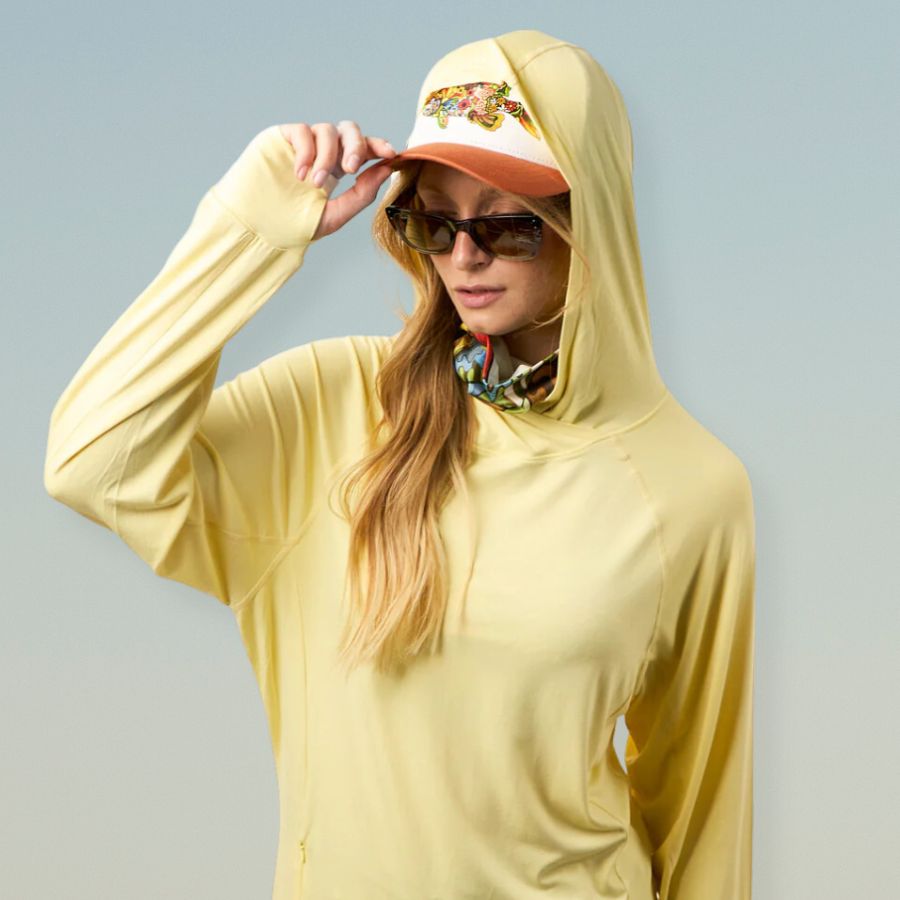
FisheWaters Solstice Hooded Sunshirt
Lightweight, quick-drying, and made with UPF 50+ sun protection, this women’s performance layer is designed for long days beside the water and beyond it.

Color Made for the Water
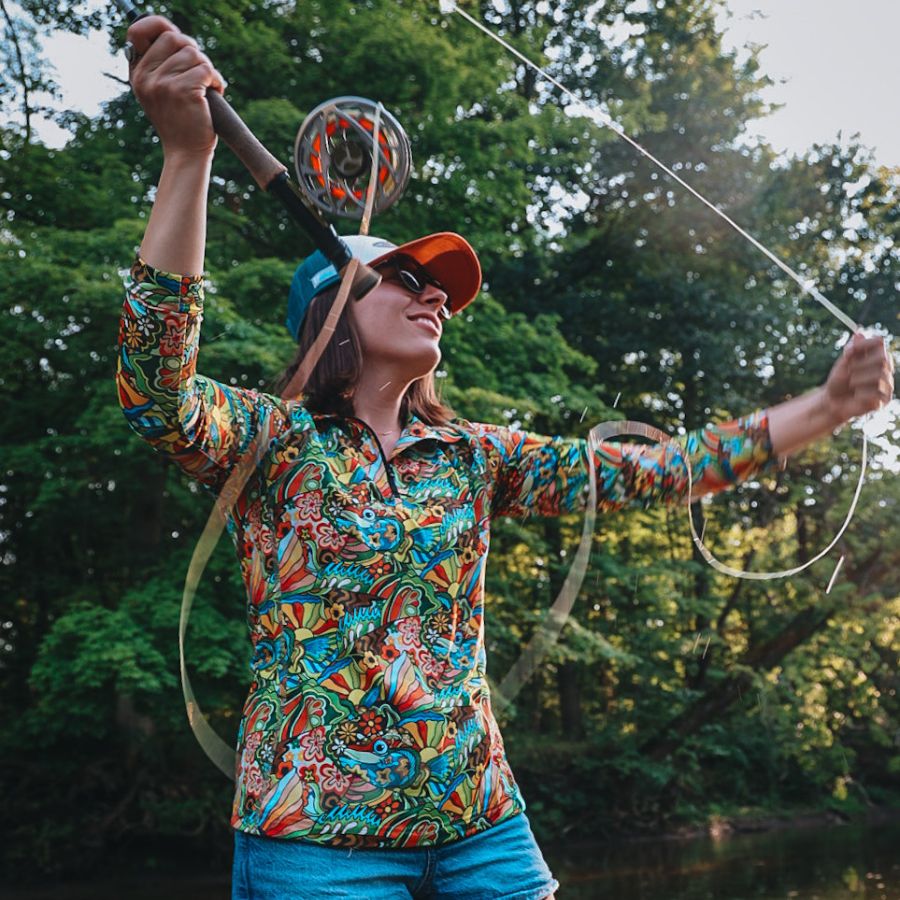
Radiant Redfish 1/4 Zip Sunshirt
A cool-touch women’s sunshirt with UPF 50+ protection and an energetic water-inspired print, made for movement through bright, exposed days.
Find Your Way to the Water
Explore women’s fishing clothes and gear designed for movement, changing weather, and days that become stories.
Fishing Has Enough Experts. It Needs More Welcoming Ones.
Thirty million people have entered outdoor recreation since 2019.
They did not arrive knowing its traditions.
They may hold the rod incorrectly. They may call a reel by the wrong name. They may wear clothing that does not resemble the familiar outdoor uniform. They may care less about performing expertise than about whether the experience feels safe, affordable, and worth repeating.
None of this weakens fishing culture. It gives fishing culture a chance to become more generous.
Every expert once stood on the bank without knowing what to do next. Every guide once misread the current. Every fly tyer once crowded the hook eye with too much thread.
Knowledge is not diminished when it is shared kindly. It becomes tradition.
And tradition, at its best, is not a locked gate. It is something passed from one set of hands to another.
Repeated time outdoors also changes what people are willing to protect. A single outing may create a pleasant memory. Five, ten, or twenty outings can create attachment—to a river, a coastline, a public access point, or the simple expectation that wild places should remain available.
That is how recreation becomes stewardship. Not through lectures. Through love repeated often enough to become responsibility.
Conclusion: The Invitation That Changes Everything
The great outdoor story of this moment is not merely that 183.2 million Americans went outside.
It is that millions of them are still deciding what the outdoors will mean in their lives.
Some will discover fishing beside a campground lake. Some will return after decades away. Some will take a child. Some will follow a friend to the river and realize, between the awkward first cast and the final light on the water, that they have found a part of themselves they did not know was missing.
They do not need to become experts immediately. They need one good experience.
A rod placed in their hands without judgment. Clothing that lets them remain comfortable when the weather changes. A question answered without condescension. A fish that follows close enough to make the heart quicken. A reason to return.
Fishing’s next generation will not arrive all at once. It will arrive quietly.
A tent zipper opening in the blue light before sunrise. Coffee steaming beside the lake. A child watching the reeds. Someone lifting a rod from against the tree and holding it out.
Do you want to try a cast?
Frequently Asked Questions
How many Americans participated in outdoor recreation in 2025?
Outdoor participation reached 183.2 million Americans in 2025, representing nearly 60% of the population age six and older.
Why is camping considered a gateway to fishing?
Camping places people close to water while giving them unstructured time to explore. More than nine in ten campers also participate in another outdoor activity, including fishing, hiking, biking, or paddling.
Are Americans spending more time outdoors?
More people are participating, but average outing frequency has fallen. Annual outings per participant declined from 87 in 2012 to 65.2 in the latest reporting.
Why are younger adults participating less?
Financial and time pressures are likely factors for adults building careers and families. The latest reporting showed declines within younger-adult participation groups.
Is fishing suitable for complete beginners?
Yes. Fishing can begin with simple equipment, accessible water, and a short outing. Beginners do not need to master every skill before enjoying time on the water.
How should families introduce children to fishing?
Keep the first outing relaxed and flexible. Choose easy water access, bring food and extra clothing, use simple equipment, and allow children to explore rather than requiring them to fish continuously.
Are more older adults participating outdoors?
Yes. Outdoor participation among Americans age 65 and older reached 23.9 million in 2025, more than double the number recorded a decade earlier.
How many women fish in the United States?
Approximately 21.3 million women participated in recreational fishing in 2024. Women represented 37% of the country’s anglers and 39% of first-time participants.
Do I have to fish often to call myself an angler?
No. There is no required number of outings. Someone who fishes a handful of meaningful days each year can have a genuine and lasting connection to the water.
Why does repeated outdoor participation matter?
Repeated outdoor experiences build confidence, familiarity, community, and a deeper connection to natural places. Over time, that relationship can encourage greater care for waterways, wildlife, public lands, and outdoor access.
Related Reading


Source Note
The outdoor participation figures and interview insights woven throughout this story originate from the Outdoor Industry Association’s 2026 Outdoor Participation Trends Report and related July 2026 industry reporting. The fishing-specific figures are supported by the Outdoor Foundation and Recreational Boating & Fishing Foundation’s 2025 Special Report on Fishing.
