

Fishing Waders for Women: What to Wear Underneath
|
|
Time to read 11 min

|
|
Time to read 11 min
Table of contents
If fishing waders for women have ever felt clammy by noon, tight through the hips by mid-afternoon, or weirdly freezing right after a sweaty hike in, the problem usually is not the waders alone. It is what is happening underneath them.
That is the part that any generic advice misses. Dressing under waders is not about cramming on more clothing and hoping for warmth. It is about building a system that manages sweat before it turns cold and gives you enough insulation without stealing mobility. The right layering under waders sits comfortably across a female body that is hiking, casting, stepping over rocks, climbing in and out of a drift boat, and sometimes standing still in cold water for long stretches.
The best under-wader setup should disappear into the day. It should slide, breathe, stretch, and regulate well enough that you stop thinking about your waistband, your thighs, your shoulders, your sock bulk, and the damp chill that shows up three hours after you overdressed.
This guide is coming from a women-first fishing point of view, not a men’s layering article with a few words swapped out at the end. Fishe’s own posture has long centered on the idea that function, fashion, and fishing belong together, and Linda Leary’s founding perspective starts from a very specific frustration: women wrestling with ill-fitting waders and watered-down gear that was never really built for how they move on the water.
It also helps that fishing deserves better apparel guidance than it often gets. The U.S. Bureau of Economic Analysis reported that boating and fishing generated $38.4 billion in current-dollar value added in 2024, making it the nation’s largest conventional outdoor recreation activity. This is not niche territory. Women deserve gear advice with the same level of seriousness.
The instinct to dress “warmer” is what gets a lot of anglers in trouble. Under waders, trapped moisture is often a bigger problem than not enough insulation. The Centers for Disease Control and Prevention (CDC) guidance is blunt about it: sweating in cold weather makes your body lose heat faster, and once you are damp, you chill more quickly. The National Institute of Safety and Health (NIOSH) also notes that overly insulated clothing, during hard effort, can create a warm microclimate that triggers sweat; when activity slows, that evaporating moisture contributes to cold stress.
That is why the right order matters more than sheer thickness:
Base layer: manage moisture next to skin.
Working layer: add breathable comfort and light regulation.
Mid layer: add warmth only when conditions truly call for it.
Outer layer: protect from wind and rain above the waders, not by stuffing more bulk underneath.
Breathable waders help, but they are not magic. Orvis notes that even breathable waders still leave some internal moisture and condensation in play, while Simms explains that wader fabrics are microporous and work best when the layers beneath them can actually move moisture away from the body.
If you get the first layer wrong, everything after it feels worse.
For cold to cool conditions, the best base layers are usually lightweight or midweight synthetics or merino wool. CDC/NIOSH cold-weather guidance recommends inner layers of wool, silk, or synthetic materials because cotton loses insulating value when wet. Merino remains especially useful because it is breathable, thermoregulating, and moves moisture vapor away from the body rather than letting sweat sit against the skin.
That means the first question is not “How warm is this fabric?” It is “What happens when I hike in, row hard, or start sweating under a shell of waterproof fabric?”
Under waders, good base layers should have flat or low-profile seams, enough stretch through the knees and hips, and a waistband that does not dig in once suspenders, belts, and hours of movement get involved. Thick brushed interiors can feel cozy in the truck and miserable after a mile-long walk to the river.
When temperatures drop below freezing, you usually need three things under your waders: a moisture-moving base layer, a real insulating mid layer, and careful sock management. The mistake is going too big too fast.
A strong setup here is a midweight merino or synthetic base, plus a breathable fleece or grid-fleece pant and top. If you run cold or expect long stationary periods in icy water, you can step up insulation on the legs before you add a bulky upper-body piece. That matters because casting suffers faster when your torso gets puffy and stiff.
Orvis recommends a moisture-wicking lightweight base plus a fleece or fleece-lined mid layer for winter fishing, along with a synthetic liner sock and a heavier wool-blend outer sock. It also warns against cotton anywhere in the system.
How to adjust it:
If you are hiking in, start a little cooler than feels emotionally comfortable. Open your jacket, skip the hat for the first part of the walk, or hold back on the heaviest mid layer until you stop moving. CDC’s winter guidance specifically advises shedding layers as soon as you start to sweat.
If you are standing in cold current for hours, focus more insulation toward your lower half and feet. If you are rowing, you may need less leg insulation than a bank angler but more wind protection for your core.
This range is tricky because it punishes overconfidence. You can be comfortable at the put-in, sweaty after a short hike, then cold by lunch once the river wind finds every damp spot.
Here, a lightweight-to-midweight base layer is usually enough against the skin, with a light fleece or grid mid layer added as needed. This is a sweet spot for pieces that are warm without being plush. The goal is loft without bulk.
Simms recommends synthetic or wool-based layers under breathable waders so moisture can move away from the body instead of leaving you wet and clammy. Woolmark’s performance guidance lines up with that logic, noting merino’s ability to thermoregulate and wick moisture vapor.
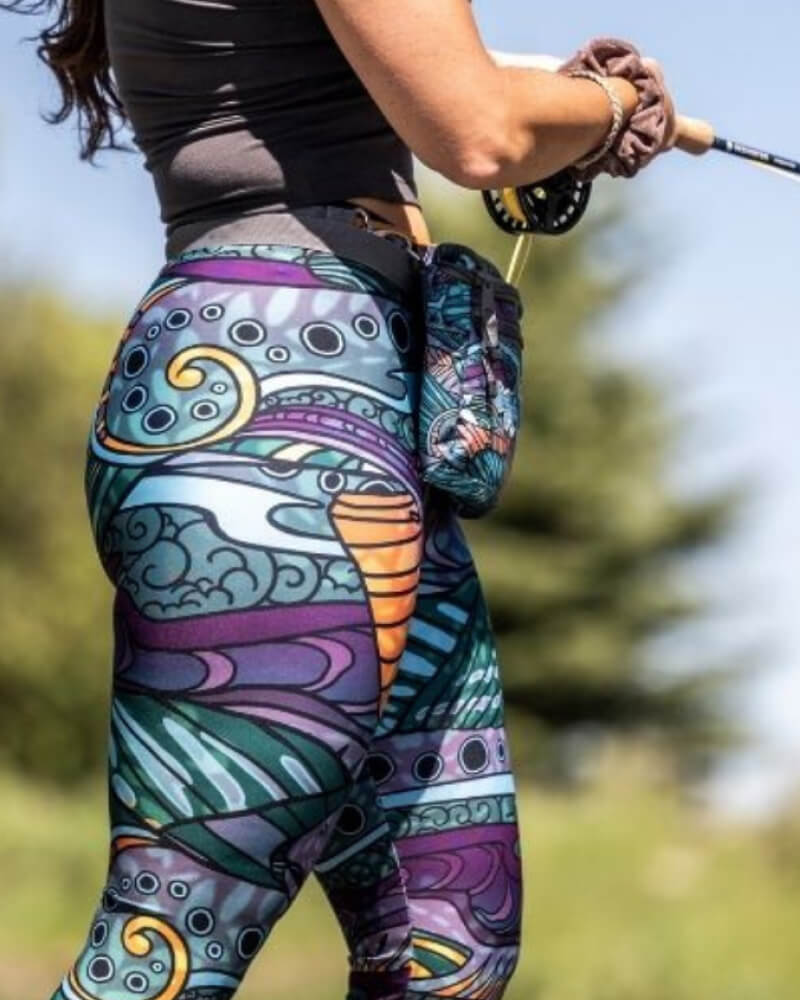
This is also the range where random leggings often fail. Many look sleek, but thick waistbands, pocket edges, compression seams, and sticky face fabrics can start to bunch under waders after a few hours. Under-wader bottoms should feel more like technical layering pieces than gym wear.
For a lot of women, this is ideal wader weather if the layering is clean. A light base layer or even a single technical next-to-skin pant may be enough on the legs, especially if you run warm. Up top, many anglers are comfortable in a lightweight long-sleeve performance layer with a shell or vest available when wind picks up.
This is where overdressing becomes the main risk. A thick fleece under breathable waders can feel fine at 7 a.m. and unbearable by 10. Because even breathable systems still trap some internal humidity, too much insulation can leave you managing moisture all day instead of fishing.
If you alternate between walking and standing, build for the walking phase and carry the warmth. It is easier to pull on an outer layer during a slow hatch window than to dry out after you soaked your own layers from the inside.
55–70°F: simplify the system
In this band, many women need much less underneath their waders than they think. The right answer is often a thin base or lightweight technical bottom only, especially if you are moving a lot, fishing from a boat, or dealing with bright sun.
Orvis’s current women’s wader designs emphasize breathability, stretch, and even waist-high conversion for dumping heat on warm walks back to the car, which is a good reminder that ventilation becomes part of comfort as conditions soften.
This is also a good range to pay attention to fabric hand. Slick, quick-drying pieces with minimal seams tend to slide better inside the wader and feel less oppressive by afternoon. Thick fleece, brushed interiors, and heavy double-knit leggings usually become a liability here.
Once the day is warm enough that you are worrying about heat, not cold, the best under-wader system is usually as little as possible without inviting chafe or stickiness. Think lightweight under-wader pants or shorts that do not bunch, plus a breathable top designed for sun and airflow above the waders.
CDC’s heat guidance emphasizes lightweight, loose clothing that allows air circulation and evaporation, and that principle still matters even inside a wader system: once sweat starts pooling faster than it can move, performance drops.
If your waders convert to waist height, use that feature. If they do not, this is the season to strip the under-layers way down before you ever step in. Warm-weather misery usually begins with good intentions and one extra layer.
What feels “fine” in a men’s or unisex layering conversation can feel terrible on a real woman’s body after six hours.
The pressure points are different. Waistbands hit differently under suspenders and belts. Hip and seat room matter more once you add extra layers. Bust and shoulder comfort affect casting rhythm. Bathroom breaks make bulky systems more annoying, which means many women tolerate discomfort longer than they should.
That is why it matters that leading brands now call out details like women-specific fit and patterning, stretch fabrics, articulated seats and legs, gusseted crotches, lower-volume booties, reduced seam stress, and low-profile seam construction in women’s waders. Those are not marketing flourishes; they directly affect how well layers sit underneath and how easily you move once the system is fully assembled.
Bulk is not neutral on a female body. It changes how waders hang, how suspenders pull, how the waist folds when you crouch, and how comfortable you feel by hour four.
The first is cotton. It absorbs moisture, holds it, and loses insulating value when wet. That is exactly the wrong behavior inside a sealed lower-body system.
The second is using insulation to solve anxiety. A lot of anglers dress for the air temperature they see at the car, not the body temperature they will generate once they start hiking, rowing, or pushing through brush. That is how you end up sweaty before you even make the first cast. CDC’s cold-weather guidance is clear: if you start sweating, remove layers.
The third is too much sock. Orvis’s winter guidance is practical here: a thin synthetic liner plus a heavier wool or synthetic sock works well, but if that combo makes your boots tight, you lose circulation and your feet get colder anyway.
The fourth is wearing pieces that are individually warm but collectively awkward: thick ankle cuffs inside neoprene booties, pocketed leggings under a wader belt, a sports bra seam that rubs under shoulder motion, or a huge fleece pant that twists every time you step up a bank. None of that sounds dramatic in the house. All of it becomes dramatic in current.
Socks
For true cold, the two-sock system still makes sense: thin synthetic liner first, heavier wool or synthetic sock second. For mild weather, one appropriately weighted performance sock is often better than stacking bulk you do not need. Performance socks are designed to wick moisture and regulate temperature, and women-specific options increasingly include seamless toes and better support zones.
Wader belt
Your wader belt is not decoration. Keep it adjusted for fit and performance, not hanging loose out of habit. Simms frames its wading belts around comfort and fit customization, and Orvis’s support-belt design shows how much brands now treat belt placement as part of all-day body comfort, not just an accessory decision.
Outer layers
In real weather, put your shell over the waders, not by stuffing more insulation underneath them. Wind and rain are better handled outside the waterproof system, where you can vent, unzip, or strip layers easily. Underneath is where you want mobility and moisture management.
If you run cold, do not automatically choose thicker layers. First ask whether you are getting cold because you were actually underdressed, or because you got damp early and then chilled later.
If you hike in, dress for the hike.
If you row, protect the core and wind-exposed areas.
If you stand still for hours, add warmth before you add bulk.
If conditions will swing all day, wear the system that gives you the widest range, not the most insulation.
That is the whole game.
The best answer to what women should wear under waders is not one outfit. It is a sequence.
Start with a layer that manages moisture. Add a breathable working layer that moves well. Bring insulation only when the day truly demands it. Keep everything low-bulk, smooth, and easy to vent. Treat socks like part of the system, not an afterthought. And remember that under-wader comfort is not about feeling warm in the parking lot. It is about still feeling good after hours of hiking, casting, standing, rowing, climbing, and adjusting to the river as it changes.
When the layering is right, your waders stop feeling like a problem to manage. They become what they should have been all along: a tool that lets you stay focused on the water.
Explore women’s layering pieces, under-wader bottoms, and technical tops that are built to move cleanly inside a wader system—and keep this guide handy the next time the forecast looks easy but the river says otherwise.
A moisture-wicking base layer plus a breathable insulating mid layer is usually the right starting point. In true cold, many women do best with merino or synthetic long underwear and a light fleece or grid-fleece layer, rather than one very bulky piece.
Not for cold or variable conditions. Cotton holds moisture and loses insulation when wet, which makes it a poor choice inside a wader system.
Sometimes, but only if they behave like true technical layering pieces. Thick waistbands, heavy seams, and brushed fabrics can bunch or overheat quickly. Under-wader bottoms should be smooth, breathable, and low-bulk.
Usually one to three, depending on temperature and activity. Start with a base layer, add a light working or mid layer if needed, and stop before mobility suffers. More is not automatically better.
In cold weather, a thin synthetic liner plus a heavier wool or synthetic sock works well. In milder temperatures, one performance sock may be enough. Avoid overfilling your boots, because tight boots reduce circulation and can make feet colder.
Not always, but women-specific layering pieces often solve real comfort problems around waist fit, hip room, seam placement, and movement. Those details matter more once everything is compressed under waders.


