

Alysia Aguilar: Fishe Ambassador, Guide & Water Advocate
|
|
Time to read 5 min
|
|
Time to read 5 min
Fishe Ambassador
Fishing, family, culture, and conservation come together in the story of Fishe ambassador Alysia Aguilar.
A guide, caregiver, mother, and advocate, Alysia has built her life around the waters that sustain her community.
Her work on Oregon’s Deschutes River is a reminder that enjoying a place also means caring for it—and helping the next generation understand why that responsibility matters.
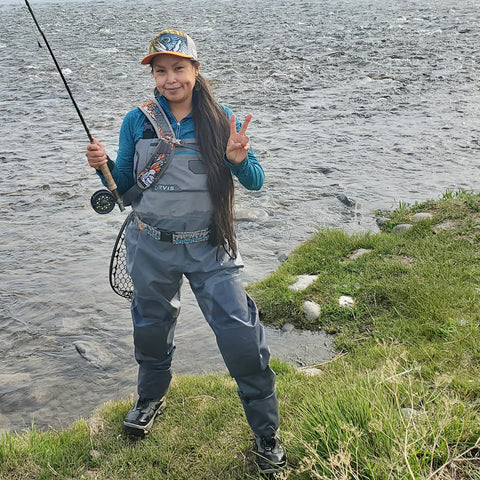
Many titles follow Alysia Aguilar: caregiver, fishing guide, Indigenous activist—the list goes on.
Hailing from Warm Springs, Oregon, Alysia lives and breathes all things water and fishing.
In 2013, she and her husband founded Littleleaf Guides on the Deschutes River, making them the first married Indigenous couple to run a fly-fishing outfit in the United States.
Water has been a connecting thread throughout Alysia’s life. Growing up in the mountainous Pacific Northwest, she had snow runoff to thank for the bountiful harvests her family needed to survive and thrive.
She grew up subsistence fishing, keeping every fish they caught and fishing with a hook and worm. Later in life, she learned how to fly fish, turning it into both a recreational pastime and a profession through guiding.
What sets Alysia and her husband’s company apart is that they are the only tribal outfit that utilizes their sovereign rights to guide.
There is an invisible line down the center of the Deschutes River that designates the west bank as private property co-managed by the Confederated Tribes of Warm Springs.
Littleleaf Guides has access to this coveted fishing area and the ability to fish the less-pressured fish stock on the left side of the river.
With all that the Deschutes River and its tributaries give to Alysia and her family business, they make an extraordinary effort to give back.
They use their guiding outfit to fulfill their duty of honoring their way of life and giving back to the land and waters on which they rely.
“By being a voice for the voiceless, number one,” as Alysia so eloquently puts it.
Littleleaf Guides raises awareness of the long list of threats facing aquatic species, plants, and the ecosystem as a whole.
Alysia is adamant that you cannot take without giving back.
She donates money to conservation nonprofits, volunteers, teaches Fly Fishing 101 classes, participates in river cleanups, and speaks about these issues through public events, podcasts, television, and magazine articles.
“Doing whatever it takes,” as Alysia says.

In 2015, Littleleaf Guides teamed up with Bark, a nonprofit dedicated to defending and restoring the natural areas around Mt. Hood.
Littleleaf Guides, Bark, and other concerned Oregonians opposed the privatization of Oxbow Springs in Cascade Locks, a city on the banks of the Columbia River.
Nestlé had proposed building a water-bottling plant there, potentially preventing millions of gallons of water from reaching the Columbia River.
In a region already struggling with drought, Alysia described salmon and sturgeon floating belly-up in the river and saw another burden on the water resource as the last thing the area needed.
In the end, the plant was not built. The company was educated about the Treaty of 1855, which gave tribes rights to hunt, fish, and harvest foods on reservation and ceded lands.
Their second major win, in 2016 and 2017, centered on protecting the Deschutes River from the threat of a crude-oil spill caused by a railroad derailment.
The railroad paralleling the tribal side of the river had not been sufficiently reinforced, increasing the risk of a derailment.
Such a spill could decimate already-stressed salmon and steelhead populations—fish that serve as food, medicine, and an essential cultural resource for Alysia and her family.
They fought and won, helping hold the railroad accountable for reinforcing bends near the river with concrete ties.
Littleleaf Guides’ activism also includes speaking at the Oregon State Capitol at the governor’s request to represent Indigenous voices and fighting threats to Sherars Falls, an important salmon dip-netting location.
“I’m very proud of growing and learning how to network with like-minded people to meet our goals. Proud of all the barriers and statistics that we have jumped over, crawled under, and made it through, regardless of the struggle it took,” says Alysia.

Not only is Alysia a guide and activist; she is also a mother.
Her children spin fish, fly fish, and Spey fish. “It’s in their DNA,” she says.
Alysia and her family’s tribe are known as the Big River People, referring to the Columbia River.
Subsistence fishing and harvesting from the land are part of their way of life, including fishing for salmon, steelhead, lamprey eel, sturgeon, mussels, and crayfish.
Alysia is driven to raise her children in their Indigenous culture and heritage.
She hopes to pass down knowledge of the oceans, rivers, and land to future generations for years to come.
Her goal is “to make my ancestors proud of me as I’m healing from generational trauma and decolonization.”
Built for Days on the Water
A few current Fishe pieces for anglers building a comfortable, capable system for long days outside.
Fishe shares stories of women whose relationship with fishing goes far beyond a day on the water.
These ambassador features center lived experience, practical knowledge, community, and conservation—and the many ways women help shape the future of fishing.
We are so thankful for Alysia’s candor in telling her story.
As the tide of human development rises, it is inspiring to know we have people like Alysia who have devoted their lives to protecting our waters and fish.
Cheers to Alysia!

Alysia Aguilar is a Fishe ambassador, fishing guide, mother, caregiver, and water advocate whose life and work are closely connected to Oregon’s Deschutes River.
Littleleaf Guides is the guiding business Alysia and her husband founded on the Deschutes River in 2013.
Alysia believes people cannot take from the land and water without giving back. Her work includes education, cleanups, public speaking, volunteering, and support for conservation organizations.
Fishing is part of her family’s way of life, cultural knowledge, food traditions, and connection to the Columbia River and surrounding lands.
She hopes to pass down knowledge of oceans, rivers, land, fishing traditions, and Indigenous culture to future generations.

Meet the women behind the Fishe ambassador program and discover how anglers, storytellers, mothers, and community builders help more women feel at home on the w

Meet Gloria Evoy and follow her path from West Coast fashion to Alaska, product development at Fishe, outdoor adventure, and practical sustainability.

Meet Kacie Samson and follow the unexpected path from a rainy Valdez camping trip and first Fishe dry bag to creative leadership, artist collaboration, and comm


